

You’ve locked the venue. The guest list is done. The flowers are decided (after three very passionate debates about peonies vs. hydrangeas). And now someone asks the question that somehow feels bigger than all of it:
“So… how are we doing the food?”
It sounds simple. It is not simple.
The way you serve food at an event shapes the entire experience: the pace, the mood, the budget, the memories. Guests who stand around a live pasta station chatting while a chef tosses linguine in front of them are having a fundamentally different night than guests seated at a formal plated dinner, linen napkin in lap, waiting for the first course.
Neither is better. But one is probably better for you.
This guide walks you through the three most popular catering service styles (buffet, plated, and live food stations) so you can make the right call for your event, your guests, and your sanity.
The Three Main Catering Service Styles, Explained
Before we get into the pros, cons, and pricing, let’s make sure we’re all on the same page about what each style actually means.
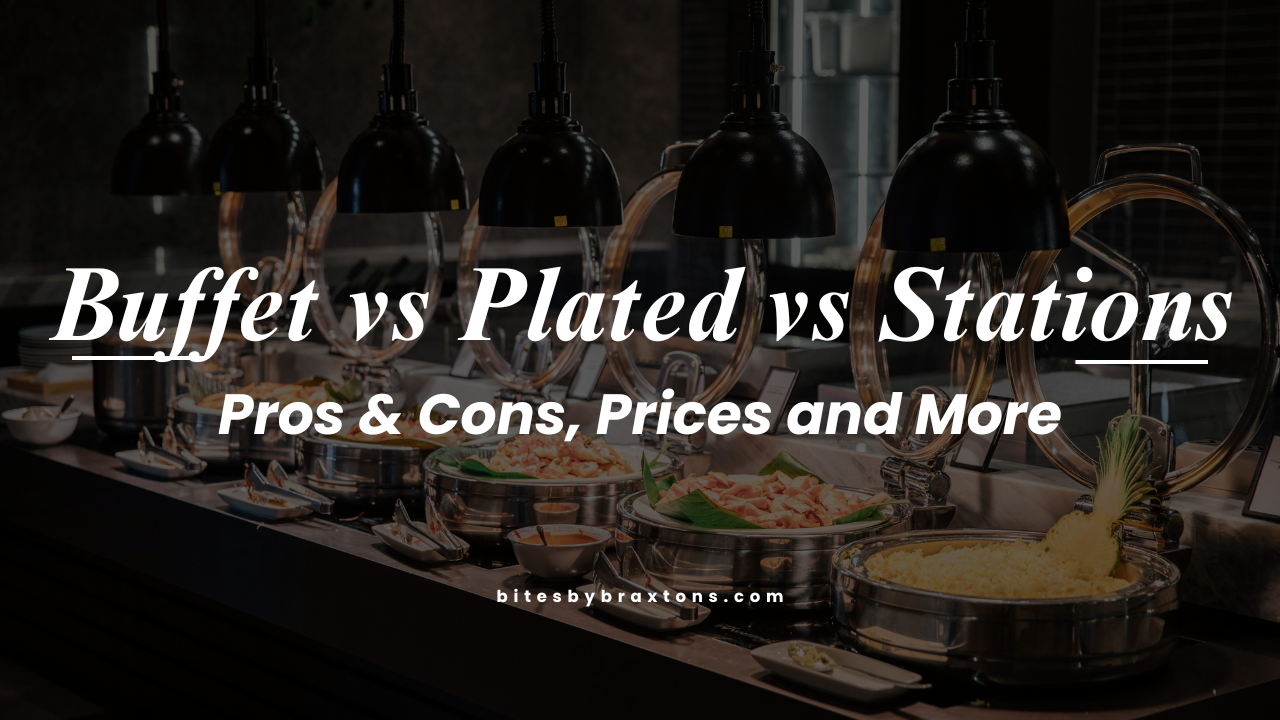
Buffet catering is a self-service format where food is laid out on tables and guests serve themselves. It’s flexible, informal, and almost universally familiar.
Plated (or “plated dinner”) service is the formal sit-down format where each guest receives individual, pre-portioned courses served directly to their seat by staff. Think black-tie wedding or corporate gala.
Live food stations (also called “action stations” or “interactive food stations”) are chef-attended setups where food is prepared or finished in front of guests. Think carving stations, live pasta bars, sushi stations, or taco bars with a chef manning the grill.
Each style has its own personality. The right choice depends on your event type, guest count, budget, and the atmosphere you’re trying to create.
Buffet Catering: The Crowd-Pleasing Workhorse
What It Is
A buffet spreads food across serving tables (hot dishes, cold dishes, salads, sides, desserts) and guests move through at their own pace, serving themselves. Staff may be present to replenish dishes and manage flow, but guests are largely self-directed.
Buffets are the most common catering format in the US for a reason. According to industry data, buffet-style service consistently ranks as the top choice for corporate events, casual weddings, school functions, and community gatherings, largely because of its flexibility and cost efficiency.
Who It’s Best For
- Corporate lunch meetings and office events
- Casual or semi-formal weddings
- Birthday parties and milestone celebrations
- School or community events
- Large groups (50 to 500+) where individual plating isn’t practical
Buffet Catering Pros
Flexibility for guests. People eat what they want, how much they want. Dietary restrictions are easier to navigate when guests can see exactly what’s in each dish.
Cost-effective per head. Buffet catering generally costs less per person than plated service. You need fewer servers, and food can be scaled up or down more easily.
Easier for large crowds. Feeding 200 people from a buffet line is dramatically more manageable than plating 200 individual meals simultaneously.
Less rigid timing. Buffets don’t require the precise kitchen coordination that plated dinners demand. The flow is more organic.
Creates natural social mixing. There’s something about a buffet line that gets people talking. Strangers bond over the pasta salad. Old friends reconnect at the carving station.
Buffet Catering Cons
Can feel less formal. If you’re going for an elevated, black-tie aesthetic, a buffet may undercut the mood no matter how beautifully it’s laid out.
Food quality can suffer over time. Hot food sitting in chafing dishes for an hour isn’t the same as food fresh off the line. Quality management is a real consideration.
Potential for long lines. Poor buffet table layout or underestimating crowd flow can create bottlenecks that frustrate guests.
Harder to control portions. Which means food costs can be harder to pin down. Some guests will pile a plate three times; others barely eat.
Buffet Catering Cost: What to Expect
| Event Size | Estimated Cost Per Person | Notes |
|---|---|---|
| Small (under 50 guests) | $25 to $45 | Higher per-head due to minimum order thresholds |
| Medium (50 to 150 guests) | $20 to $35 | Most cost-efficient range |
| Large (150 to 300+ guests) | $15 to $30 | Economy of scale kicks in |
These are general estimates for full-service buffet catering including setup, staffing, and equipment. Prices vary significantly by region, caterer, and menu complexity.
Plated Dinner Service: The Formal Experience
What It Is
Plated service (sometimes called “plated dinner catering” or “sit-down dinner service”) is the most formal catering style. Guests are seated, and trained servers bring individually portioned courses directly to the table. A typical plated dinner might include an appetizer, salad, entrée, and dessert with each course timed and coordinated.
This is the format you see at formal weddings, black-tie galas, award dinners, and upscale corporate events. It communicates one thing clearly: this occasion matters.
Who It’s Best For
- Formal weddings, especially plated wedding receptions
- Black-tie corporate events or galas
- Award ceremonies and fundraising dinners
- Intimate dinner parties (under 100 guests)
- Events where the dining experience is the centerpiece
Plated Service Pros
Elegance and atmosphere. There’s nothing quite like a beautifully plated entrée arriving in front of you. It signals that guests are being taken care of, intentionally.
Portion and cost control. Every plate is pre-portioned, which means you know exactly how much food is being served and can plan costs precisely.
Food quality at its peak. Plated food is prepared closer to service time, which means better temperature, fresher presentation, and higher overall quality.
Structured event flow. A plated dinner gives your event a clear timeline: cocktail hour, first course, main, dessert, speeches. That structure can be a real asset for formal events.
Feels like hospitality. Being served (genuinely served) is a different emotional experience than helping yourself. For certain events, that feeling is worth paying for.
Plated Service Cons
More expensive. More staff, more kitchen coordination, more time. It all adds up. Plated service is typically the most expensive catering format per head.
Less flexible for dietary needs. Managing 200 individual dietary restrictions across a plated service requires meticulous coordination. One missed vegan meal at table 12 becomes an incident.
Slower pace. Plated dinners move at the kitchen’s pace, not the guests’. For events that need energy and movement, that can feel constraining.
Not great for large crowds. Beyond 300 to 400 guests, plated service becomes logistically complex and expensive enough that most event planners start steering toward alternatives.
Plated Dinner Catering Cost: What to Expect
| Event Size | Estimated Cost Per Person | Notes |
|---|---|---|
| Small (under 50 guests) | $65 to $120 | Full plated service with staff |
| Medium (50 to 150 guests) | $55 to $100 | Most common range for weddings and galas |
| Large (150 to 300 guests) | $50 to $90 | Requires significant staffing investment |
Plated dinners require more servers per guest (typically 1 per 8 to 10 guests vs. 1 per 25 to 30 for buffets), which is a major driver of the higher cost. According to the National Restaurant Association, staffing is consistently cited as the top cost variable in formal catering service.
Live Food Stations: The Experience-First Option
What It Is
Live food stations (also called action stations, interactive food stations, or chef stations) are the most experiential catering format. A chef or trained server prepares, finishes, or carves food in front of guests in real time. Guests engage directly, customize their plates on the spot, and watch the magic happen.
Popular live station ideas include:
- Carving stations (prime rib, whole roasted turkey, leg of lamb)
- Live pasta stations (fresh pasta tossed to order)
- Sushi or poke bowl stations (chef-attended, fully customizable)
- Taco or fajita bars (with live grilling)
- Mac and cheese bars (yes, really, and they’re always a hit)
- Crepe stations (sweet or savory, made to order)
- Omelet stations (popular for breakfast and brunch events)
- Waffle or pancake stations
- Dessert stations (chocolate fondue, s’mores, custom sundae bars)
Who It’s Best For
- Weddings that want personality and energy
- Corporate events focused on networking and guest engagement
- Milestone birthdays, anniversaries, and celebrations
- Cocktail-style receptions with no formal seated dinner
- Any event where you want food to be a talking point
Live Station Pros
Pure entertainment value. Watching a chef hand-roll sushi or shave prime rib at a carving station is genuinely engaging. The food becomes part of the event’s atmosphere.
Maximum customization. Guests build their own plates, choose their own toppings, request their preferred doneness. Dietary accommodations happen naturally and in real time.
Drives conversation and connection. Live stations create natural gathering points. People linger, chat, come back for seconds. It’s social in a way that a seated dinner simply isn’t.
Memorable. Ask guests what they remember most about an event and it’s often the interactive pasta station or the chef who made them a custom crepe. Food experiences stick.
Flexible format. Live stations work beautifully with cocktail-hour formats, where guests mingle freely rather than being anchored to a seat.
Live Station Cons
Higher cost than buffet. You’re paying for chef talent, specialized equipment, and a more complex setup. It’s more expensive than a buffet, though often less than full plated service.
Lines can form. Popular stations (especially at peak hunger moments) can generate waits if not managed well. More stations or staggered opening helps.
Space requirements. Live stations need more floor space than a traditional buffet or plated setup. Small venues may not accommodate them comfortably.
Complex logistics. Multiple stations with different chefs, equipment, and food prep timelines require a well-coordinated catering team.
Live Food Station Catering Cost: What to Expect
| Station Type | Estimated Cost Per Person | Notes |
|---|---|---|
| Basic station (taco bar, pasta) | $20 to $40 | Depends on ingredients and staffing |
| Premium station (carving, sushi) | $35 to $65 | Requires skilled chef attendance |
| Full event (multiple stations) | $45 to $85 | Most events combine 3 to 5 stations |
Side-by-Side Comparison: Buffet vs Plated vs Live Stations
| Factor | Buffet | Plated Dinner | Live Stations |
|---|---|---|---|
| Formality | Casual to Semi-formal | Formal | Semi-formal to Festive |
| Cost per head | $ (Lowest) | $$$ (Highest) | $$ (Mid-range) |
| Guest experience | Familiar, relaxed | Elegant, structured | Interactive, memorable |
| Food quality control | Moderate | Highest | High (fresh to order) |
| Dietary flexibility | Good | Challenging | Excellent |
| Best event size | Any (50 to 500+) | Small to medium (up to 300) | Any (with planning) |
| Staffing needs | Low to moderate | High | Moderate to high |
| Social atmosphere | Relaxed | Formal | Energetic |
| Customization | Limited | Low | High |
| Setup complexity | Low | High | High |
| Best for | Corporate, casual weddings | Galas, formal weddings | Celebrations, networking events |
How to Choose: The Right Format for Your Event
Still not sure? Run through these four questions and they’ll get you to an answer faster than anything else.
1. What’s your budget?
If you’re working with a tight per-head budget, buffet is your friend. It’s the most cost-effective way to feed a crowd well. If budget is flexible and the event is formal, plated service is the elevated choice. Live stations sit comfortably in the middle, more experiential than a buffet and less expensive than full plated service.
2. What atmosphere are you creating?
Formal and elegant? Plated. Warm, social, and relaxed? Buffet. Fun, energetic, and memorable? Live stations. Match the food service style to the event’s emotional tone. They should feel like the same party.
3. How large is your group?
Under 75 people: any format works well. 75 to 200 people: buffet and live stations handle this range beautifully; plated is doable but requires serious staffing investment. 200 to 500+ people: buffet is the practical workhorse; live stations can supplement; full plated service at this scale is rare for good reason.
4. What do you want guests to feel?
Taken care of and celebrated? Plated. Free to mingle and enjoy themselves? Buffet or live stations. Like they’re at the best party they’ve attended in years? Live stations, almost certainly.
Mixing Formats: The Best of All Worlds
Here’s something a lot of first-time event planners don’t know: you don’t have to pick just one.
Many of the best-catered events I’ve seen (and eaten at) use a combination. A cocktail hour with two live stations for engagement. A seated dinner with plated entrées. A dessert buffet to close the night on a sweet, relaxed note.
Mixing formats lets you match the energy of each part of your event with the right service style. It also gives guests variety, which is one of the most underrated elements of a great event experience.
Talk to your caterer about hybrid approaches. A good catering team will have opinions on what combinations work well for your specific venue, guest count, and event flow.
Catering Service Style for Specific Events: Quick Reference
| Event Type | Recommended Style | Why |
|---|---|---|
| Formal wedding reception | Plated dinner or plated + dessert buffet | Elegance, structure, and guest care |
| Casual or outdoor wedding | Buffet or live stations | Relaxed atmosphere, social energy |
| Corporate conference lunch | Buffet | Speed, efficiency, dietary flexibility |
| Corporate gala or awards night | Plated dinner | Formal, polished, event-appropriate |
| Birthday party (milestone) | Live stations or buffet | Fun, interactive, crowd-friendly |
| Networking event | Live stations (cocktail-style) | Drives conversation and movement |
| Brunch or morning event | Live omelet/waffle stations + buffet | Fresh, engaging, crowd-pleasing |
| School or community event | Buffet | Budget-friendly, universally accessible |
| Fundraising dinner | Plated dinner | Matches the gravitas of the occasion |
Frequently Asked Questions
Which catering style is cheapest: buffet, plated, or live stations?
Buffet is almost always the most affordable option per person. You need fewer servers, food prep is less complex, and scaling up is straightforward. Plated service is typically the most expensive due to higher staffing ratios and kitchen coordination demands.
What is the difference between buffet and plated service?
Buffet is self-service: guests walk to the food. Plated service is where food is brought directly to each guest’s seat in individual portions. Plated is more formal and controlled; buffet is more relaxed and flexible.
Are live food stations worth the extra cost?
For the right event, yes, genuinely. Live stations create an experience guests remember. If your event prioritizes atmosphere, interaction, and memorability, the extra investment in live stations is almost always worth it.
How many live stations do I need for my event?
A general rule: plan for one station per 50 to 75 guests to avoid long wait times. For a 200-person event, 3 to 4 stations is a reasonable starting point.
Can I mix buffet and plated service at the same event?
Absolutely. Many caterers offer hybrid formats, for example a plated appetizer course followed by a buffet-style main, or a plated dinner with a dessert station. Discuss options with your caterer.
What is an action station at a catering event?
Action station is another term for a live food station: a chef-attended setup where food is prepared or finished in real time in front of guests. Common examples include pasta stations, carving stations, and sushi bars.
Which catering style is best for a wedding?
It depends entirely on the wedding’s vibe. Formal weddings traditionally use plated service. Relaxed or outdoor weddings often thrive with buffet or live stations. Many modern weddings combine formats for variety and energy.
How far in advance should I book a caterer?
For large events (100+ guests), booking 6 to 12 months in advance is standard, especially for weddings. Smaller events may have more flexibility, but 2 to 3 months is a safe minimum for any catered function.
What’s the most popular catering style for corporate events?
Buffet is by far the most common for corporate events. It’s efficient, flexible, and accommodates diverse dietary needs without complicated coordination.
Is plated service always more expensive than a buffet?
In almost all cases, yes. The staffing ratio alone makes plated service more costly. You need significantly more servers per guest compared to a buffet setup.
Final Thoughts
Here’s the truth: there’s no universally “best” catering style. There’s only the right catering style for your event.
Buffet catering is the dependable, flexible, crowd-pleasing choice that works for almost any occasion where formality isn’t the primary goal. Plated dinner service is the gold standard when you want guests to feel genuinely hosted, every detail considered, every course timed, every plate a statement. Live food stations are for when you want the food itself to become part of the event’s energy, its memory, its story.
What I always tell people is this: start with the feeling you want your guests to leave with, then work backward. Do you want them to feel pampered? Plated. Do you want them to feel like they had the best time? Live stations. Do you want them fed well without fuss so they can focus on everything else happening? Buffet.
Get that feeling right, and the food service style almost chooses itself.
Disclaimer: Pricing estimates in this article reflect general market ranges as of early 2026 and will vary by region, caterer, menu complexity, and event requirements. Always request itemized quotes from multiple caterers before finalizing your event budget.
Curated by Bites by Braxtons,
Flavorful beginnings, unforgettable endings.